Product Details
| 种属 |
Human (Homo sapiens) |
| UniProt号 |
P55263 |
| 缩写 |
ADK |
| 别名 |
AK; Adenosine 5'-Phosphotransferase |
| 线性范围 |
1.56-100 ng/mL |
| 灵敏度 |
1 ng/mL |
| 样本类型 |
Serum, Plasma, Other biological fluids |
| 检测方法 |
Sandwich |
| 分析方法 |
Quantitive |
| 反应时间 |
1-4.5h |
| 样本体积 |
1-200 μL |
| 检测波长 |
450 nm |
原理
This assay employs a two-site sandwich ELISA to quantitate ADK in samples. An antibody specific for ADK has been pre-coated onto a microplate. Standards and samples are pipetted into the wells and anyADK present is bound by the immobilized antibody. After removing any unbound substances, a biotin-conjugated antibody specific for ADK is added to the wells. After washing, Streptavidin conjugated Horseradish Peroxidase (HRP) is added to the wells. Following a wash to remove any unbound avidin-enzyme reagent, a substrate solution is added to the wells and color develops in proportion to the amount of ADK bound in the initial step. The color development is stopped and the intensity of the color is measured.
产品概述
Adenosine deaminase is an enzyme (EC 3.5.4.4) involved in purine metabolism. It is needed for the breakdown of adenosine from food and for the turnover of nucleic acids in tissues.Plays an important role in purine metabolism and in adenosine homeostasis. Modulates signaling by extracellular adenosine, and so contributes indirectly to cellular signaling events. Acts as a positive regulator of T-cell coactivation, by binding DPP4. Its interaction with DPP4 regulates lymphocyte-epithelial cell adhesion.
ADA exists in both small form (as a monomer) and large form (as a dimer-complex). In the monomer form, the enzyme is a polypeptide chain, folded into eight strands of parallel α/β barrels, which surround a central deep pocket that is the active site. In addition to the eight central β-barrels and eight peripheral α-helices, ADA also contains five additional helices: residues 19-76 fold into three helices, located between β1 and α1 folds; and two antiparallel carboxy-terminal helices are located across the amino-terminal of the β-barrel.
Its primary function in humans is the development and maintenance of the immune system. However, the full physiological role of ADA is not yet completely understood.
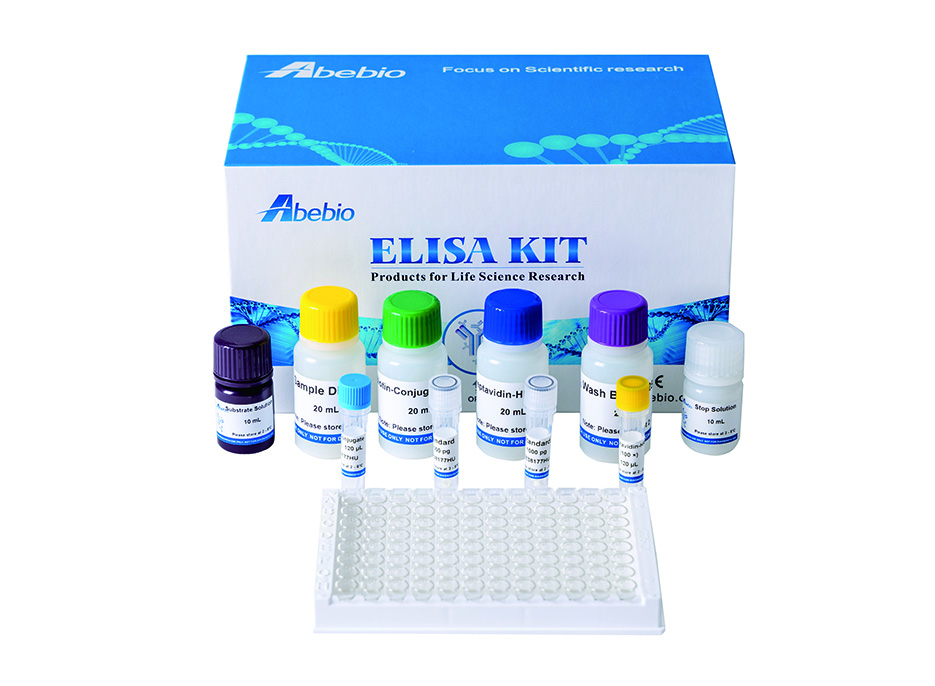
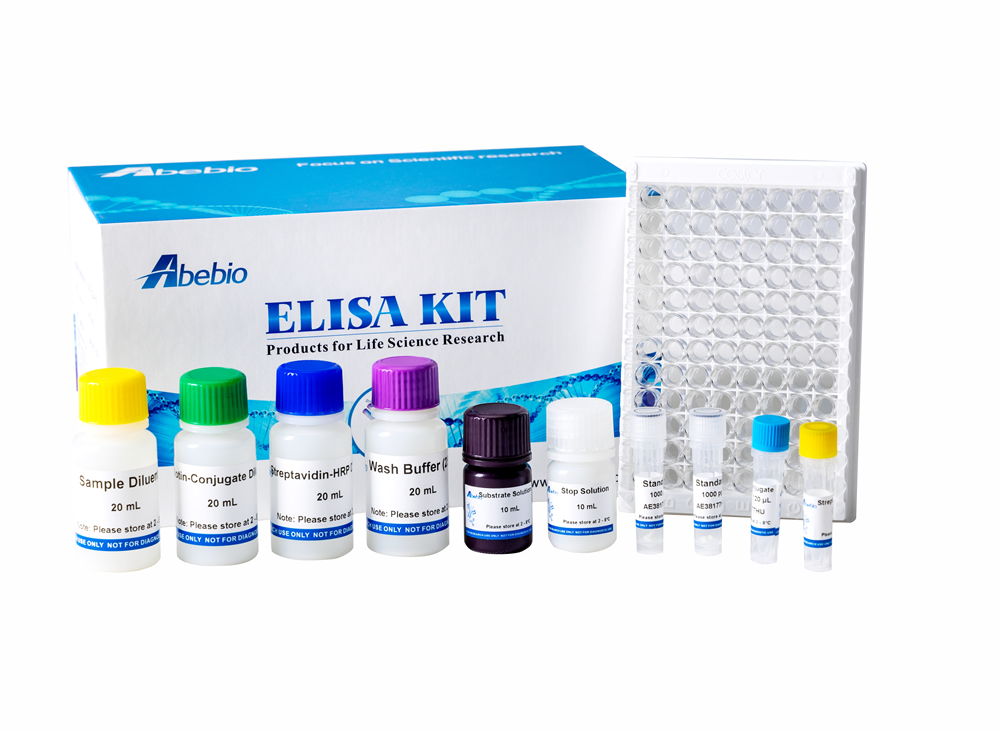
组份
Reagents |
Quantity |
Reagents |
Quantity |
Assay plate (96 Wells) |
1 |
Instruction manual |
1 |
Standard (lyophilized) |
2 |
Sample Diluent |
1 x 20 mL |
Biotin-Conjugate (concentrate 100 x) |
1 x 120 μL |
Biotin-Conjugate Diluent |
1 x 12 mL |
Streptavidin-HRP (concentrate 100 x) |
1 x 120 μL |
Streptavidin-HRP Diluent |
1 x 12 mL |
Wash Buffer (concentrate 25 x) |
1 x 20 mL |
Substrate Solution |
1 x 10 mL |
Stop Solution |
1 x 6 mL |
Adhesive Films |
4 |
特异性
This assay has high sensitivity and excellent specificity for detection of Human ADK. No significant cross-reactivity or interference between Human ADK and analogues was observed.
回收率
Matrices listed below were spiked with certain level of recombinant Human ADK and the recovery rates were calculated by comparing the measured value to the expected amount of Human ADK in samples.
精密度
Intra-assay Precision (Precision within an assay)
Three samples of known concentration were tested twenty times on one plate to assess intra-assay precision.
Inter-assay Precision (Precision between assays)
Three samples of known concentration were tested in forty separate assays to assess inter-assay precision.
CV (%) = SD/meanX100
Intra-Assay: CV<8%
Inter-Assay: CV<12%
线性
The linearity of the kit was assayed by testing samples spiked with appropriate concentration of Human ADK and their serial dilutions. The results were demonstrated by the percentage of calculated concentration to the expected.
稳定性
The stability of ELISA kit is determined by the loss rate of activity. The loss rate of this kit is less than 5% within the expiration date under appropriate storage condition.
The loss rate was determined by accelerated thermal degradation test. Keep the kit at 37°C for 4 and 7 days, and compare O.D.values of the kit kept at 37°C with that of at recommended temperature. (referring from China Biological Products Standard, which was calculated by the Arrhenius equation. For ELISA kit, 4 days storage at 37°C can be considered as 6 months at 2 - 8°C, which means 7 days at 37°C equaling 12 months at 2 - 8°C).
样本收集及储存
Serum: Use a serum separator tube (SST) and allow samples to clot for two hours at room temperature or overnight at 2 - 8°C before centrifugation for 15 minutes at 1000 × g. Remove serum and assay immediately or aliquot and store samples at ≤ -20°C. Avoid repeated freeze-thaw cycles.
Plasma: Collect plasma using EDTA, or heparin as an anticoagulant. Centrifuge for 15 minutes at 1000 × g at 2 - 8°C within 30 minutes of collection. Assay immediately or aliquot and store samples at ≤ -20°C. Avoid repeated freeze-thaw cycles.
Other biological fluids: Centrifuge samples for 20 minutes at 1000 × g. Remove particulates and assay immediately or store samples in aliquot at -20°C or -80°C. Avoid repeated freeze/thaw cycles.
注意事项
Store at 2-8°C. Please refer to Instruction Manual.



 电话:
 邮箱:
 地址: