Product Details
| 种属 |
Rat (Rattus norvegicus) |
| UniProt号 |
|
| 缩写 |
RELB |
| 别名 |
I-REL; IREL; REL-B; reticuloendotheliosis viral oncogene homolog B|v-rel avian reticuloendotheliosis viral oncogene homolog B (nuclear factor of kappa light polypeptide gene enhancer in B-cells 3)|v |
| 线性范围 |
0.31-20 ng/mL |
| 灵敏度 |
0.1 ng/mL |
| 样本类型 |
Serum, Plasma, Other biological fluids |
| 检测方法 |
Sandwich |
| 分析方法 |
Quantitive |
| 反应时间 |
1-4.5h |
| 样本体积 |
1-200 μL |
| 检测波长 |
450 nm |
原理
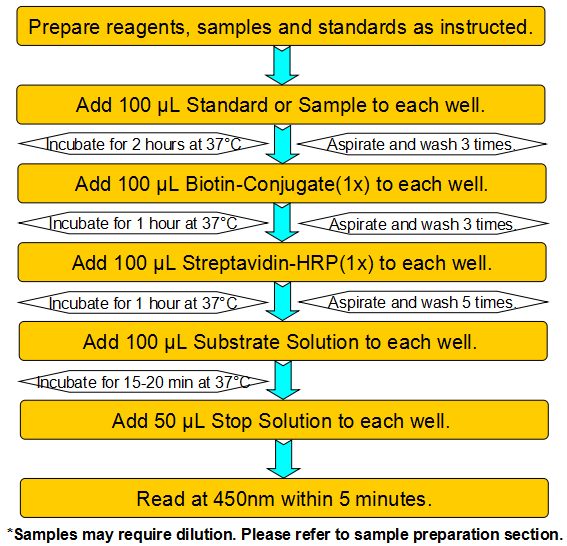
This assay employs a two-site sandwich ELISA to quantitate RELB in samples. An antibody specific for RELB has been pre-coated onto a microplate. Standards and samples are pipetted into the wells and anyRELB present is bound by the immobilized antibody. After removing any unbound substances, a biotin-conjugated antibody specific for RELB is added to the wells. After washing, Streptavidin conjugated Horseradish Peroxidase (HRP) is added to the wells. Following a wash to remove any unbound avidin-enzyme reagent, a substrate solution is added to the wells and color develops in proportion to the amount of RELB bound in the initial step. The color development is stopped and the intensity of the color is measured.
产品概述
Bours et al. (1994) demonstrated that human RELB, when generated in mammalian cells, formed kappa-B-binding heterodimeric complexes with p50 (NFKB1) or p52 (NFKB2). Homodimeric complexes of RELB did not show DNA-binding activity.NF-kappa-B-inducing kinase (NIK, or MAP3K14) is required for osteoclastogenesis in response to pathologic stimuli. Vaira et al. (2008) found that overexpression of Relb, but not Rela, rescued differentiation of mouse Nik -/- osteoclast precursors, indicating that blockade of the alternative NF-kappa-B pathway, rather than the classical NF-kappa-B pathway, is responsible for the osteoclastogenic defect in the absence of Nik. Using Relb -/- mice, they showed that Relb itself was required for Rankl-induced osteoclastogenesis in vitro and for TNF-induced bone resorption in vivo
组份
Reagents |
Quantity |
Reagents |
Quantity |
Assay plate (96 Wells) |
1 |
Instruction manual |
1 |
Standard (lyophilized) |
2 |
Sample Diluent |
1 x 20 mL |
Biotin-Conjugate (concentrate 100 x) |
1 x 120 μL |
Biotin-Conjugate Diluent |
1 x 12 mL |
Streptavidin-HRP (concentrate 100 x) |
1 x 120 μL |
Streptavidin-HRP Diluent |
1 x 12 mL |
Wash Buffer (concentrate 25 x) |
1 x 20 mL |
Substrate Solution |
1 x 10 mL |
Stop Solution |
1 x 6 mL |
Adhesive Films |
4 |
特异性
This assay has high sensitivity and excellent specificity for detection of Rat RELB. No significant cross-reactivity or interference between Rat RELB and analogues was observed.
回收率
Matrices listed below were spiked with certain level of recombinant Rat RELB and the recovery rates were calculated by comparing the measured value to the expected amount of Rat RELB in samples.
精密度
Intra-assay Precision (Precision within an assay)
Three samples of known concentration were tested twenty times on one plate to assess intra-assay precision.
Inter-assay Precision (Precision between assays)
Three samples of known concentration were tested in forty separate assays to assess inter-assay precision.
CV (%) = SD/meanX100
Intra-Assay: CV<8%
Inter-Assay: CV<12%
线性
The linearity of the kit was assayed by testing samples spiked with appropriate concentration of Rat RELB and their serial dilutions. The results were demonstrated by the percentage of calculated concentration to the expected.
稳定性
The stability of ELISA kit is determined by the loss rate of activity. The loss rate of this kit is less than 5% within the expiration date under appropriate storage condition.
The loss rate was determined by accelerated thermal degradation test. Keep the kit at 37°C for 4 and 7 days, and compare O.D.values of the kit kept at 37°C with that of at recommended temperature. (referring from China Biological Products Standard, which was calculated by the Arrhenius equation. For ELISA kit, 4 days storage at 37°C can be considered as 6 months at 2 - 8°C, which means 7 days at 37°C equaling 12 months at 2 - 8°C).
样本收集及储存
Serum: Use a serum separator tube (SST) and allow samples to clot for two hours at room temperature or overnight at 2 - 8°C before centrifugation for 15 minutes at 1000 × g. Remove serum and assay immediately or aliquot and store samples at ≤ -20°C. Avoid repeated freeze-thaw cycles.
Plasma: Collect plasma using EDTA, or heparin as an anticoagulant. Centrifuge for 15 minutes at 1000 × g at 2 - 8°C within 30 minutes of collection. Assay immediately or aliquot and store samples at ≤ -20°C. Avoid repeated freeze-thaw cycles.
Other biological fluids: Centrifuge samples for 20 minutes at 1000 × g. Remove particulates and assay immediately or store samples in aliquot at -20°C or -80°C. Avoid repeated freeze/thaw cycles.
注意事项
Store at 2-8°C. Please refer to Instruction Manual.



 电话:
 邮箱:
 地址: